
In the old days, Sunday was a hard stop.
Shops were closed, phones went to voicemail, and customers didn’t expect to hear from anyone until Monday morning. That world is gone.
Today, business is 24/7.
Order something from Amazon at 2:00am and, depending on where you live, it might be on your doorstep by lunchtime. Your customers have been trained to expect instant responses, real-time updates, and frictionless buying—whether you’re Amazon or a three-person landscaping company.
Online retailers adjusted. Most traditional businesses haven’t.
Hair salons, dentists, landscapers, builders, chiropractors, gyms, restaurants—the majority still operate on “office hours.” If a customer wants to book an appointment, reschedule, or get a quick answer, they have to remember to call during a narrow window of time.
Outside that window? Voicemail, and voicemail in 2025 is just a polite way of saying, “Please go call my competitor.”
Right now, literally as you read this, someone is staring at their yard thinking, “I really need to get someone in to sort this out.”
It might be Sunday afternoon. It might be 9:30pm on a Wednesday. What matters is their intent in that moment.
If they call a landscaping company and hit a message that says, “We’re closed, call back Monday,” most won’t. They’ll hit back, search again, and go with whoever picks up or lets them book on the spot.
The same thing happens with:
-
The person who wants a haircut before next weekend.
-
The person who tweaks their back on a Sunday and wants a chiropractor.
-
The parent trying to schedule a dentist appointment after the kids are in bed.
Small businesses are quietly bleeding money because they’re not available when customers are ready to buy.
Missed calls, missed forms, missed chats—those are missed dollars. And in many cases, those customers don’t circle back. They choose the path of least resistance.
This is exactly where AI changes the game.
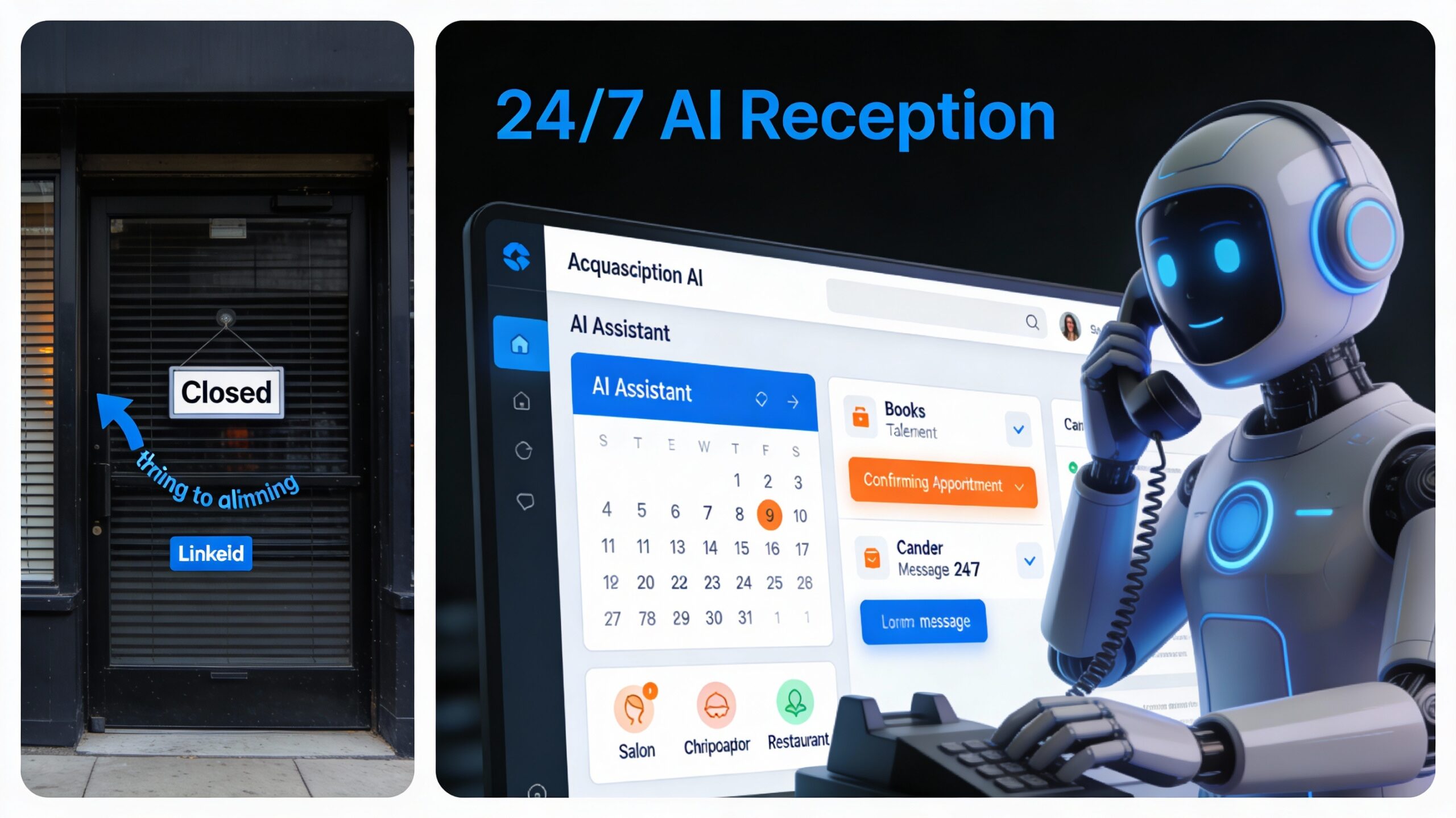
With today’s tools, you can train AI to:
-
Answer inbound calls and web inquiries.
-
Check availability against a calendar.
-
Offer alternative times.
-
Book the appointment.
-
Send confirmations and reminders.
It doesn’t get tired. It doesn’t call in sick. It doesn’t take weekends or vacations.
It just handles business—24/7.
To match that with humans, you’re looking at multiple salaries, scheduling headaches, and coverage gaps. Full 24/7 reception support can easily run toward six figures a year, which is why almost no small business does it.
An AI-driven “receptionist” flips that equation.
You get:
-
Always-on coverage.
-
Consistent professionalism.
-
A fraction of the cost of full-time staff.
That’s how I got started in my AI business and why I built Acquasition AI around the idea of an AI Growth Engine—systems that turn missed opportunities into booked revenue, automatically.
The receptionist model is just one entry point. It’s a simple, powerful example that makes the opportunity obvious.
But it’s only the beginning.
There are dozens of AI-powered services small businesses will happily pay for—lead capture, follow-up, qualification, scheduling, review generation, pipeline management, and more. All built around the same core promise:
Better. Faster. More efficient. Lower cost. Without asking the owner to work nights and weekends to keep up.
And here’s the exciting part:
Most small businesses are only just waking up to what’s possible.
The ones who move first, who install AI as part of their growth engine instead of bolting it on as a gadget, are going to feel like they suddenly stepped into the 24/7, always-on economy their customers are already living in.
That’s the world Acquasition AI is building for.