
After four decades in this game, one thing is clear, lead generation used to be mostly guesswork and grind. Today, AI finally lets small teams run like a well-funded sales organization—if you wire it in the right way.
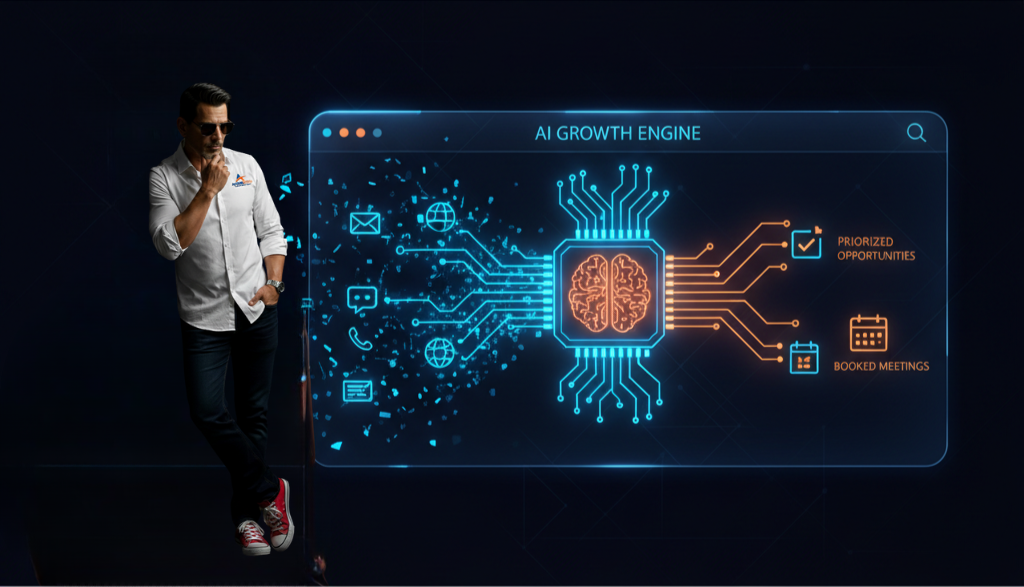
Together, that stack becomes what Acquasition AI calls an AI Growth Engine: a system that pulls you out of manual hustle and into predictable pipeline.
Predictive Lead Scoring: Who’s Actually Worth Your Time? Most teams burn hours on the wrong people. AI fixes that. Instead of “spray and pray,” machine learning builds a picture of your best customers and compares every new lead to that picture. It looks at things like company size and industry, role, past buying patterns, and behavior across your site and emails, then gives each lead a simple score and a short “why this matters” summary you can act on.
Think of it as a metal detector tuned to your ideal buyer, not every shiny object on the beach. The important part: the model learns from outcomes. As you close or lose deals, the scoring gets sharper, and your team gets both a number and a set of reasons—so reps know who to chase and how to approach them, not just which list to dial.
Intent & Behavior: Reading What Prospects Are Really Telling You Clicks and visits are noise until you know which ones matter. AI watches for high-intent behavior: coming back to pricing, downloading comparison guides, spending extra time on offer pages, searching for integration details, and so on.
Natural language processing takes what people read and say, chat, email, forms, and maps it into intent buckets. “Does this work with Salesforce?” is flagged as an integration concern. Repeat trips to case studies say, “Show me proof.” Instead of guessing where someone is in the buying journey, your system surfaces patterns that match real buying stages. That lets you time the next touch and match your message to what they’re actually thinking about, not what you hope they care about.
Automated Research: Turning 30 Minutes of Prep Into 30 Seconds Old way: a rep spends half an hour per account on LinkedIn, websites, and Google, then still sends a generic email. New way: AI does that grind for you.
Your system can scan public profiles, news, hiring pages, tech stacks, and past activity, then enrich the record with context that actually helps you sell: recent funding, new locations, tools they use, signals they’re growing or consolidating. Instead of a blank screen, reps get a short brief: who they are, what’s changing in their world, what pain is likely on the table, and who else in that account might matter. That shifts outreach from “just checking in” to “here’s a timely reason we should talk.”
How AI Qualifies Leads (Without Becoming a Black Box) Here’s the basic flow you want under the hood:
- Data capture – Your system collects web sessions, email engagement, social touches, forms, and CRM history.
- ICP analysis – It learns from your closed‑won deals and defines what “good” actually looks like for your business.
- Lead scoring – Every lead gets a score based on both fit (who they are) and behavior (what they do).
- Segmentation – Leads are dropped into lanes: price-sensitive, SMB, mid‑market, enterprise, partner, and so on.
- Real-time updates – New actions—like a pricing-page visit—bump the score and can trigger alerts or sequences.
- Continuous learning – Outcomes feed back in, so the next round of scoring and routing gets smarter.
The key point: this should be a measurable workflow, not magic. Keep your outcome labels clean—what counts as a “real opportunity,” what counts as “closed”—so the AI learns from truth, not noise.
Personalized Outreach at Scale (Without Sounding Like a Robot) Good outreach still wins deals. AI just lets you do it at volume. Using the data you’ve collected, AI can draft subject lines, email bodies, and snippets that match the prospect’s company size, tech environment, and recent behavior. It can test variations, promote the winners, and recommend the best times and channels to reach out based on past engagement. When you do this well, you see conversion lifts that compound as volume grows—studies show AI-assisted optimization can materially increase on-site and funnel conversion rates, often in the double digits. For a small team, even a 20–30% bump across the funnel is the difference between “barely keeping up” and “we can finally plan growth.”
AI Agents and Virtual Assistants: Junior Reps That Never Sleep This is where most teams finally feel the shift. AI agents sit on your site, inside your calendar flow, and even on inbound channels. They greet visitors, answer common questions, collect qualification data, and update records in real time. When they spot high intent, they can either book a call or hand the lead to a human with a short brief: “Here’s who they are, what they’re asking about, and why they’re a fit.” You keep humans where humans matter—discovery, strategy, pricing, closing—and let agents handle the repetitive front-end. The net effect: fewer dropped balls, better out-of-hours coverage, and a pipeline that moves even when nobody is “on the phones.”
Why the Old Way Breaks as You Grow Most teams cling to manual research, gut-feel prioritization, and ad-hoc follow-up because it feels safe and familiar. That works when you have a handful of leads. As volume grows, it blows up.
- Context lives in people’s heads and in scattered notes.
- Timing slips because nobody is watching signals in real time.
- Follow-up becomes inconsistent; the loudest lead wins, not the best.
At that point, you don’t have a sales process—you have chaos that happens to close deals. What AI brings, when it’s wired right, is structure: signal collection, scoring, routing, and sequencing that run in the background so your team doesn’t have to reinvent the wheel on every prospect.
From Firefighting to Predictable Pipeline This is exactly why platforms like Acquasition AI exist: to pull all of these pieces into one AI Growth Engine instead of handing you a pile of tools. When you centralize signals, automate enrichment and scoring, and tie intent directly to booked time on the calendar, a few things happen:
- Response times drop.
- Missed opportunities shrink.
- Your cost to acquire a customer comes down because you’re not wasting touches on bad fits.
Real Risks, Real Guardrails Now the warning label. Automation doesn’t just speed up what works—it also speeds up your mistakes. If you train models on bad data or biased outcomes, they’ll score the wrong leads high and the right ones low. If you push personalization too far without guardrails, you go from “relevant” to “creepy” in one email. The pattern is simple:
- Good data + clear rules = AI makes you faster and more precise.
- Messy data + no oversight = AI helps you lose trust at scale.
A Simple Way to Think About It Treat AI like a seasoned assistant you’ve just hired. Its job is to watch signals, summarize prospects, and propose next steps. Your job is to decide which moves to greenlight and which to shut down until the patterns are proven. Over time, as the assistant proves it can call the right plays on your numbers, you let it run more of the game. That’s how small teams in 2025 and beyond stop trying to “work harder” at lead generation—and start building AI Growth Engines that make revenue feel a lot less random.